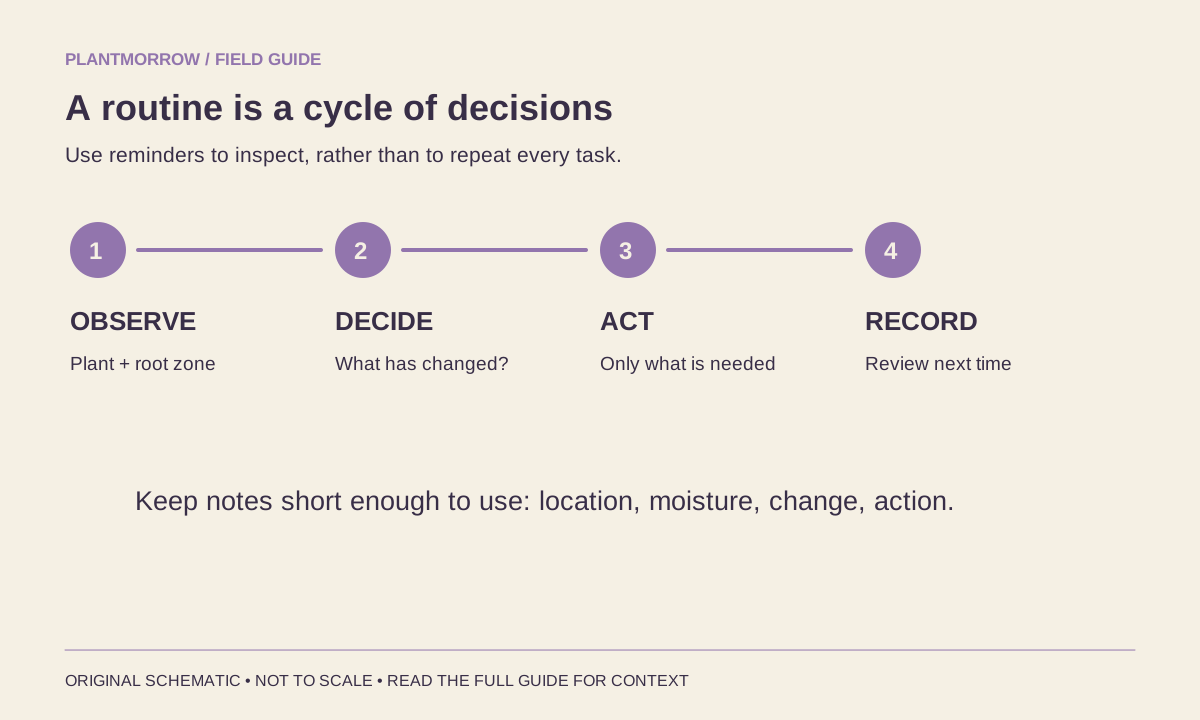
A useful plant care routine schedules observation before it schedules action. Put a reminder on your calendar to check the plants, then decide what each one needs from its condition and growing environment. Watering every pot on the same day, adding fertilizer because a month has passed and repotting whenever you feel concerned are actions without enough information behind them.
The aim is not to create a complicated tracking system. It is to make a few important checks easy to repeat, notice change sooner and avoid unnecessary work. This routine is designed for an ordinary indoor collection, with adjustments for seedlings, newly acquired plants and anything recovering from a problem.
Begin with an inventory you will actually use
Give each plant a recognizable name and location. A botanical name is valuable when you can identify it confidently, but an honest temporary description is better than an incorrect identification copied from a photograph. Keep the purchase label or record where your identification came from so you can revisit uncertainty later.
Note the pot type, whether it has drainage and whether it sits inside a cover pot. Hidden containers create hidden maintenance tasks: water may remain below an inner pot long after the visible surface looks tidy. Put this detail on the inventory rather than relying on memory.
Record the plant’s general light and moisture requirements from a reliable species-specific source. The Oklahoma State houseplant care guide describes the combination of light, water, temperature, nutrition and growing medium that shapes indoor care. Use those factors to organize your notes instead of collecting isolated tips.
Start with a single page, a small spreadsheet or a card beside the collection. If maintaining the record takes longer than looking at the plants, simplify it. The system is successful when it helps you make a better decision, not when it contains the largest number of fields.
Build a check, not a universal watering day
Choose a regular opportunity to look at the plants. The appropriate checking frequency depends on what you grow: tiny propagation pots, warm balcony containers and slow-growing indoor specimens can change at very different speeds. A weekly collection review can be useful, but it does not replace more frequent attention where conditions require it.
At each pot, look at the foliage and inspect the growing medium appropriately for that plant. Combine more than one clue where possible, such as deeper moisture and the weight of the pot. A dry-looking surface does not tell you everything about the root zone, and a heavy pot can be informative when you know its usual condition.
Water only when the evidence supports it, using a method appropriate for the plant and pot. Check that excess water can escape, and remove accumulated drainage from saucers or outer containers. The watering guide explains why inspection is more useful than a fixed interval applied to the whole collection.
Record a meaningful exception rather than every small detail. A note such as still moist below surface, check again soon helps prevent an automatic second watering by another household member. A blank entry should not be mistaken for evidence that a plant has been neglected.
Make a short observation circuit
Move through the collection in the same order. Look first at the overall shape, then at a few leaves, stems and the pot. A consistent route makes it easier to remember where you stopped and prevents the most attractive plants from receiving all the attention.
Notice new growth, changes in color, damaged areas and whether the plant is leaning toward light. Turn a leaf over where it is practical and look at its underside and attachment. You are gathering clues, not trying to diagnose every minor mark during a hurried inspection.
Check nearby conditions too. A heating vent, newly opened curtain, air-conditioning draft or moved piece of furniture can change a plant’s environment without altering the pot itself. A routine that looks only at leaves may miss the reason those leaves are changing.
The University of Missouri care guide explains common cultural factors affecting houseplants. Your observation circuit turns those general factors into questions about one particular location: has the light changed, is the medium drying differently, and is the plant responding consistently?
Give new arrivals their own track
A newly acquired plant should not immediately be treated as if its history matches the rest of your collection. Inspect it, identify the inner pot and growing medium, and find out whether it was recently watered or fed. A decorative outer container can hide a very different nursery setup underneath.
Keep new or questionable plants apart while you observe them for pests and other problems. Make the separation practical enough that you will maintain it rather than placing the newcomer among everything else because there is no convenient surface available. Do not claim that a fixed number of days guarantees the absence of pests.
Avoid performing every possible maintenance job on arrival. Unless a specific condition requires action, allow yourself time to understand how the plant behaves in its new location. Immediate repotting, pruning, feeding and relocation can produce a confusing sequence of changes.
Create a temporary note for the newcomer: where it is, what you noticed, what has already been done and what would trigger the next step. Once its condition is stable and you understand its needs, incorporate it into the ordinary circuit instead of keeping a special treatment schedule indefinitely.
Use a monthly review for context
A broader review can focus on the environment rather than on routine watering. Look at the available light, the way growth is developing and whether the potting arrangement still makes sense. The date is a reminder to review these conditions, not an instruction to make a change.
Check that leaves are reasonably free from accumulated dust using a cleaning approach suitable for their surface. Delicate, hairy or easily marked foliage may require different handling from smooth leaves. Avoid polishing every plant with a household product simply to produce a shiny appearance.
Inspect supports, ties and the stability of taller plants. A tie that was loose earlier can become restrictive as a stem changes, and a climbing plant may need its support repositioned. Make small adjustments without using a maintenance session as an excuse for unnecessary disturbance.
Review nutrition separately. Check whether the medium already contains fertilizer and whether the plant is actively growing before deciding to feed. The feeding planner keeps that decision connected to conditions and product instructions rather than a universal monthly dose.
Let the seasons change the questions
Observe what seasonal change means in your home. Shorter days, different sun angles, heating and summer heat can alter the light and drying patterns around the same window. Month names alone are not enough, especially for readers in different hemispheres or climates.
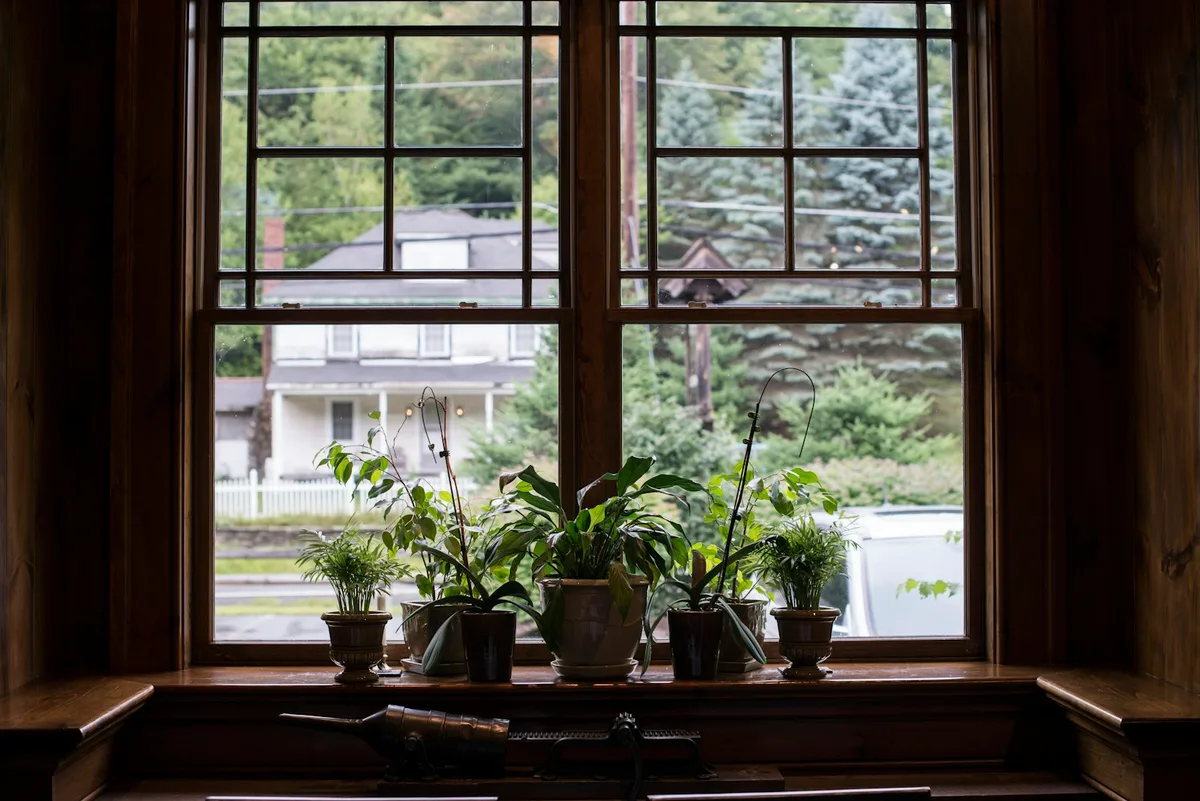
The University of Minnesota lighting guide describes the importance of indoor light conditions. During a seasonal review, look at the actual window environment rather than assuming that the brightest location remains equally bright throughout the year.
Adjust one condition thoughtfully. A plant that dries more slowly under reduced light may need less frequent watering after inspection, not a fixed percentage reduction taken from someone else’s schedule. A plant near hot glass may need protection or a gradual position change rather than more water alone.
Keep seasonal notes short and descriptive: morning sun now reaches this shelf, the room is cooler overnight, or this pot stays wet longer. Such observations are more useful for the next year than a rule that says all plants received the same treatment on the first day of a month.
Work with care groups, while keeping exceptions visible
You can group plants with similar requirements to make checking easier, but a shared group should not erase individual differences. A small terracotta pot and a larger plastic pot may dry differently even when the plants have similar needs and stand side by side.
Group by the care question, not by appearance. Succulent-looking foliage is not a complete identification, and a collection of tropical-looking leaves does not automatically share one moisture preference. Confirm what you grow before building a rule around it.
For a hypothetical household with eight plants, you might create three checking routes: ordinary foliage plants, drier-growing plants and propagation or recovery pots. The routes tell you where to look. They do not instruct you to pour the same amount of water into every member of a group.
Use visible notes for exceptions. If a plant has recently been repotted or is being monitored for a problem, mark that status so that another person does not unknowingly follow the usual routine. Remove the temporary note when it no longer describes the situation.
Keep a problem log that preserves useful clues
When something changes, photograph the affected area and the whole plant. Record when you first noticed it, which leaves are involved and any recent changes to location or care. This creates a reference before you trim away damaged material or alter several conditions at once.
Choose a next observation and a sensible review point. For example, you may want to know whether additional leaves are affected, whether the medium remains wet or whether a visible insect returns. A problem log should narrow uncertainty, not become a long list of every possible disease.
Avoid combining several untested treatments. If you change the watering, medium, feeding and light immediately, a later improvement or decline tells you little about the cause. Urgent conditions can require prompt action, but ordinary troubleshooting usually benefits from a clear sequence.
Use the plant problems section to choose a relevant guide and seek appropriate local advice when identification or treatment is uncertain. A routine is a way to notice problems earlier; it is not a guarantee that every symptom can be diagnosed at home.
A record small enough to keep
| Field | Useful entry | Unhelpful substitute |
|---|---|---|
| Observation | Lower medium still moist | Plant seems unhappy |
| Action | Checked drainage; no watering today | Gave extra care |
| Context | Moved away from heating vent yesterday | Something changed recently |
| Follow-up | Watch whether new leaves are affected | Keep trying treatments |
Keep the observation separate from your interpretation. Wet medium is an observation; root rot is a possible explanation that needs further evidence. This distinction makes your record more useful if you later ask someone for help.
There is no need to weigh every pot or measure every leaf. Use measurements when they answer a particular question, and write down their limitations. A simple repeatable observation is often more valuable than a precise-looking number whose meaning you do not understand.
Questions about making the routine stick
What if I can only check plants at the weekend?
Choose plants and growing setups compatible with the attention you can provide, but do not assume every plant will fit a weekly interval. Some small or fast-drying pots need more frequent checks. Arrange appropriate help or change the setup where necessary rather than ignoring those requirements.
Should I use an app for every task?
An app can store notes and reminders, but it cannot observe your root environment for you. Use notifications as prompts to inspect, not automatic watering instructions. A paper card can work just as well if it helps you notice change and communicate with other carers.
How should someone else care for plants while I travel?
Leave plant-specific instructions, identify which pots need checking and explain how to assess them. Avoid a single instruction to water everything daily. Show the person the actual drainage arrangement and any exceptions before leaving, and keep product use simple rather than asking them to improvise.
What is the first habit to establish?
Make the observation circuit easy enough to repeat. Learn what each plant and pot looks and feels like under ordinary conditions. That familiarity gives later changes context. Add detailed records only where they improve a decision, instead of starting with a tracking system you will abandon.
Start with the next round of observation
Name the plants, locate their drainage and choose a convenient checking route. At the next review, inspect first and act second. A reliable routine is not one that performs the most tasks; it is one that consistently connects the task to something the plant actually needs.
Read further
Sources & further reading
Selected horticultural references used to inform this guide. Local conditions and species-specific advice still matter.
- Houseplant Care — Oklahoma State University Extension
- Caring for Houseplants — University of Missouri Extension
- Lighting for indoor plants and starting seeds — University of Minnesota Extension
Prepared with AI assistance for Plantmorrow. No independent expert review or first-hand growing trial is claimed. Our editorial approach · Suggest a correction.