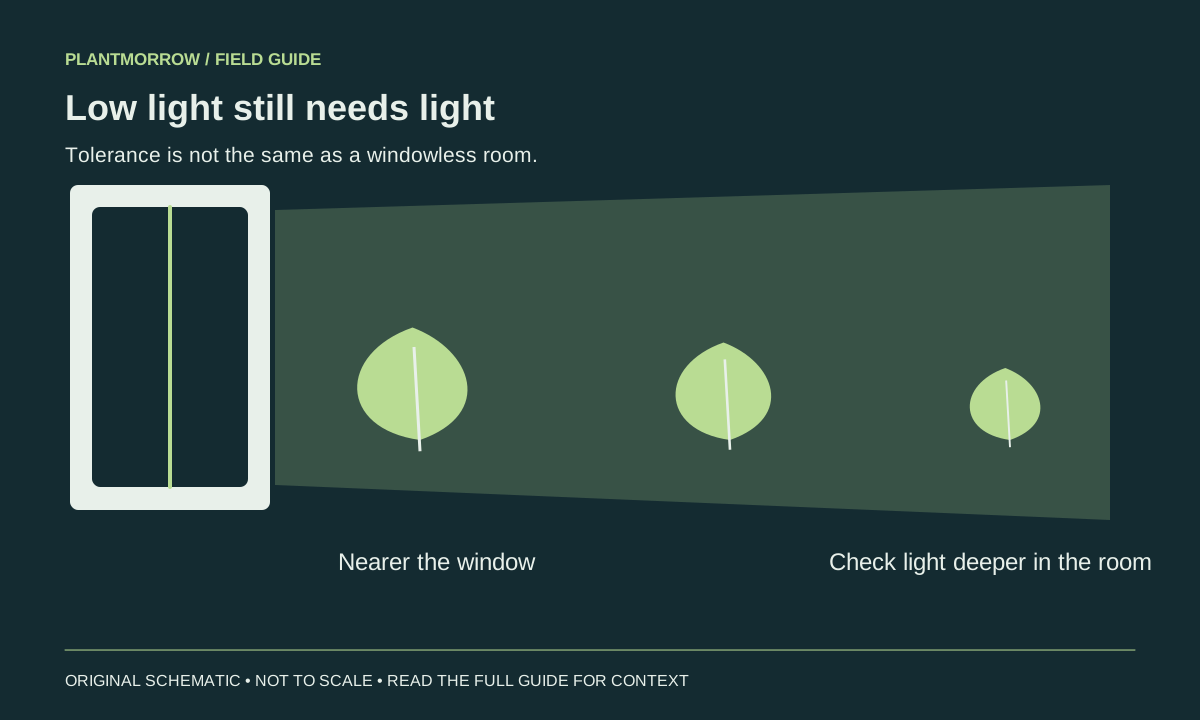
The best indoor plants for low-light rooms are plants whose normal growth can tolerate the light you actually have: snake plants, ZZ plants, cast-iron plants, pothos, some Chinese evergreens, and parlor palms are useful candidates. None can grow indefinitely in complete darkness. A dim room with a usable window is a different environment from a windowless bathroom lit only when someone enters.
Choose a plant for its combination of light tolerance, watering needs, mature size, and suitability around your household. A shortlist is helpful only when it leads to a realistic match. These field cards explain the differences between six candidates, then show how to test a position and maintain a plant without mistaking slow decline for successful low-light growing.
First identify what “low light” means in your room
Low light is a growing condition, not an interior color scheme. A dark-painted room with an unobstructed window can offer more usable light than a white room behind deep balconies and neighboring buildings. Visit the proposed position at several times of day. Notice whether daylight reaches the leaves and whether the room remains dim even at its brightest.
The plant’s position matters more than the room’s name. A shelf beside a window and a shelf across the same room are different sites. Window orientation is only a clue because hemisphere, season, trees, glazing, curtains, and outside obstructions all change the result. Use the indoor light notebook to assess these conditions without relying on a universal distance from glass.
Low-light tolerance also does not promise dense growth or abundant flowers. A plant may survive while producing smaller, slower, or less strongly patterned growth. The RHS’s shady-room guidance offers useful species choices, but the practical task is still matching each plant to a real position.
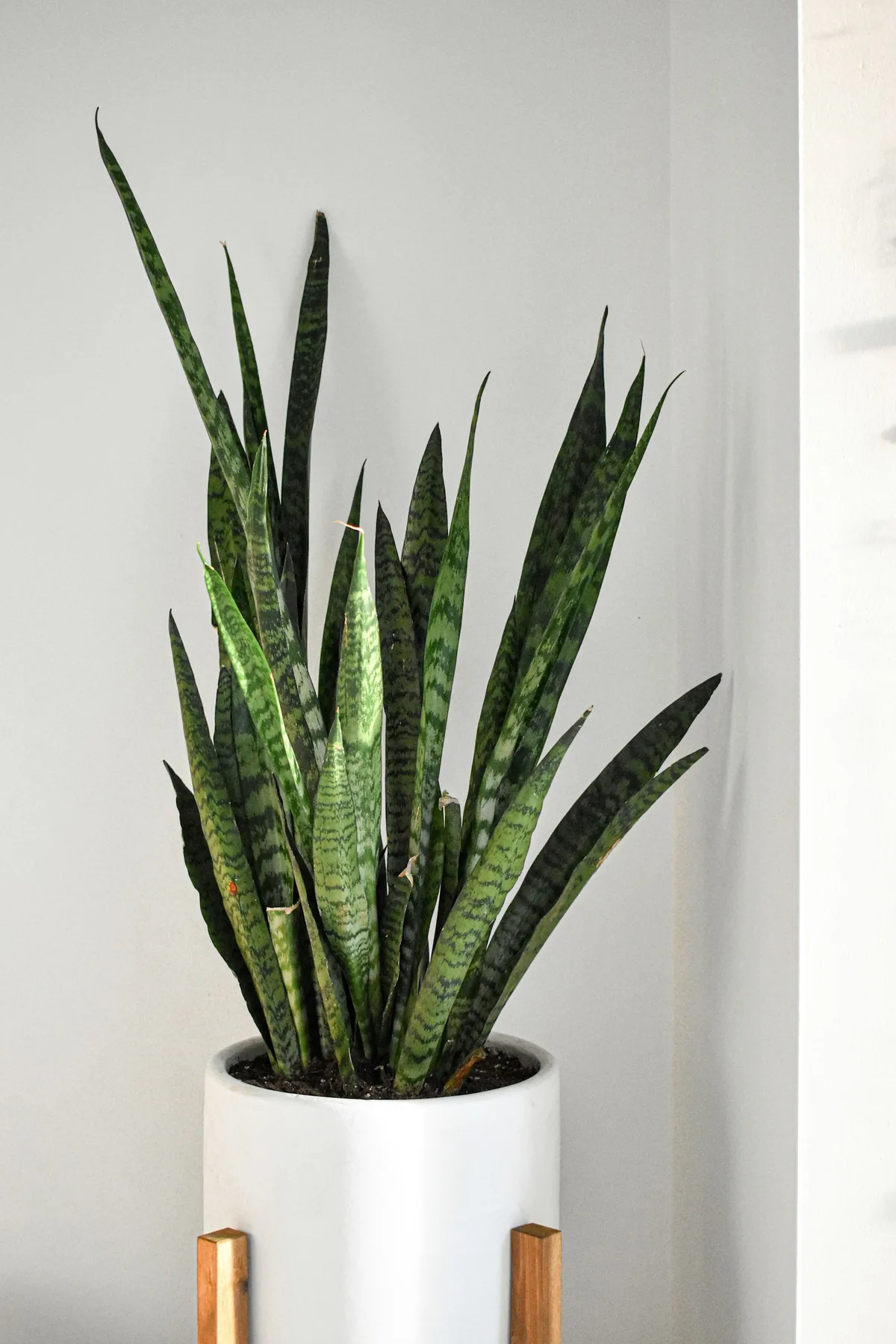
Field card 01: snake plant, Dracaena trifasciata
Look for: upright, firm leaves and a clear architectural shape. Snake plants suit people who want a relatively compact footprint, although the eventual height and spread depend on the species or cultivar.
Why consider it: snake plants are commonly recommended for tolerance of lower light. Their ability to store water means the care rhythm is very different from that of a thin-leaved plant in a constantly moist pot.
The trade-off: lower light is not permission to keep the roots wet. Check the medium before watering and use a well-drained container. Avoid buying a snake plant for a sealed decorative pot simply because the display looks tidy. A healthy plant and a practical pot are a better pairing than a dramatic shape with no workable drainage.
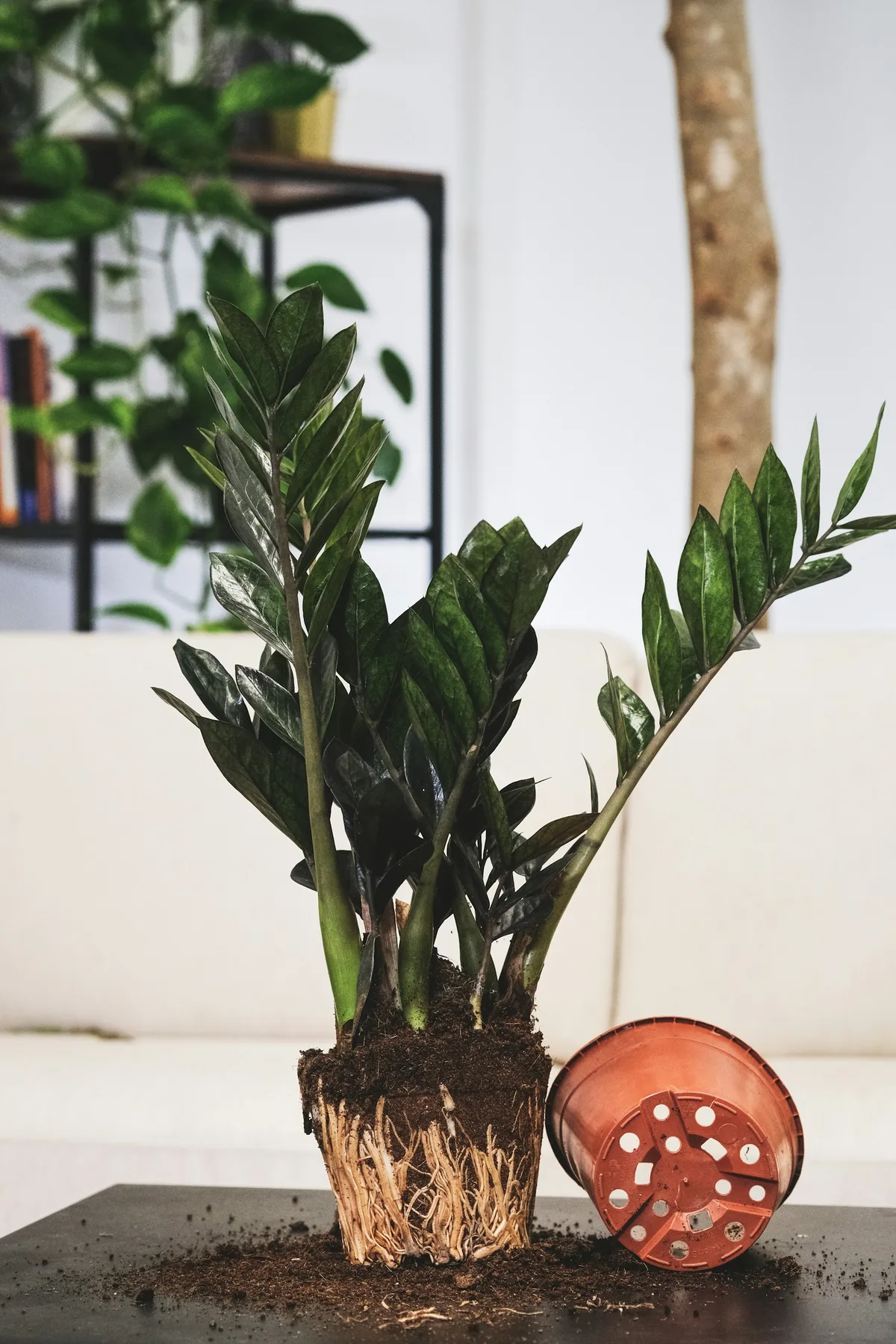
Field card 02: ZZ plant, Zamioculcas zamiifolia
Look for: glossy leaflets along upright stalks. A ZZ plant can make a strong visual statement without requiring a mass of trailing stems. Allow space for the whole plant rather than treating each stalk as an isolated ornament.
Why consider it: ZZ plants tolerate a range of indoor light conditions and can be useful where growth will naturally be slower. They also store water, making restraint around a still-wet pot particularly important.
The trade-off: slow growth can make problems less obvious at first. Check the lower medium and drainage instead of adding water because the surface looks dusty. A large pot around a small root system is not a shortcut to faster growth. Match the container to the plant, and expect patience rather than a rapid transformation of a dim corner.
Field card 03: cast-iron plant, Aspidistra elatior
Look for: broad, leathery leaves rising from the base. Cast-iron plants create a quieter, less spiky shape than snake plants and work well where you want the foliage itself to carry the display.
Why consider it: their reputation for shade tolerance makes them a sensible candidate for an adequately lit but less sunny room. The RHS identifies cast-iron plants among dependable shady-room options.
The trade-off: tolerant does not mean immune to neglect. Dust can obscure leaf appearance, and an inaccessible pot still makes care difficult. Check the plant’s eventual dimensions before squeezing it between furniture. When choosing a patterned cultivar, verify its specific light needs rather than assuming every selection performs exactly like the plain green form.
Field card 04: pothos, Epipremnum aureum
Look for: a trailing or climbing habit, with leaves spaced along flexible stems. Pothos is useful when a shelf or support is part of the design, but leave enough access to inspect the pot and the backs of leaves.
Why consider it: it can tolerate lower-light positions better than many sun-demanding plants. A relatively straightforward growth habit also makes it easier to see new leaves and notice changes in the length between them.
The trade-off: a plant that grows sparse, stretched stems is not necessarily asking for fertilizer. Reassess light first. Strongly variegated forms may need brighter conditions to maintain their appearance. If you want a fuller display, start with an appropriate plant and position rather than planning to conceal every weak stem behind another object.
Field card 05: Chinese evergreen, Aglaonema
Look for: a bushier foliage display, often with patterned leaves. Chinese evergreens offer a different visual texture from upright snake plants or trailing pothos, but the group contains many cultivars with different appearances.
Why consider it: some selections are useful candidates for lower-light interiors. The exact plant identity matters more than a label that simply says “Aglaonema mix.” Ask for the cultivar or at least a reliable botanical identification when buying.
The trade-off: do not generalize from one green-leaved plant to every brightly colored selection. Match the care guidance to the plant you bring home. Protect it from unsuitable temperature extremes as well as poor light; a dark entrance beside a frequently opened cold door can combine two problems. Choose a stable indoor position where the leaves can be observed easily.
Field card 06: parlor palm, Chamaedorea elegans
Look for: finer fronds and a softer outline. A parlor palm can provide a different feel from broad, solid foliage, especially where you want texture without a large-leaved specimen dominating the room.
Why consider it: it is often chosen for indoor locations with gentler light. Its structure can make an attractive small-space plant when you allow the fronds room to spread instead of brushing constantly against a wall.
The trade-off: do not give it a snake plant’s watering treatment just because both appear on a low-light shortlist. Thin foliage and different roots bring different requirements. Look for a practical balance of light, moisture, and indoor conditions. Avoid presenting any palm as a universal pet-safe choice without checking the exact identity: similar common names can refer to very different plants.
Match the candidate to your habits
Start with the maintenance you can realistically provide. If you tend to add water whenever you pass a plant, a drought-tolerant species in a dim position may be a poor match unless you are willing to change that habit. If you frequently forget to inspect plants, a species that needs more even moisture may create unnecessary difficulty.
Next, consider access and shape. An upright plant may suit a narrow area, while a trailing plant needs safe room for its stems and an accessible pot. Check mature size rather than buying for the small nursery version alone. Leave enough space to remove the inner pot, empty runoff, and inspect new growth.
Finally, check the household context. Keep plants out of chewing reach where appropriate and consult a reliable toxicity reference for the exact species if children or animals are involved. “Indoor,” “easy,” and “low light” are growing descriptions, not safety certifications. Maryland Extension’s plant-selection guidance is a useful starting point for matching plant characteristics to the home.
Test one position before building a collection
Buy one suitable plant first and observe it in the proposed location. Record the starting condition with a simple photograph. Note the date, window access, and any obvious obstructions. Then watch actual new growth rather than judging success from the fact that the original leaves remain green for a short time.
A hypothetical example: you place a pothos on a shelf beside a window and consider a second shelf deeper inside the room. If the first plant produces compact new growth but a cutting on the deeper shelf becomes stretched, that difference is useful evidence. It does not establish an exact light measurement, but it suggests that the positions are not equivalent.
If daylight is inadequate, reconsider the position or use suitable supplemental lighting. Do not keep buying increasingly “tough” plants for the same unsuitable site. Penn State’s discussion of low-light houseplants illustrates why observation and placement matter alongside the species list.
Adjust watering for slower growth
Lower usable light often means that a plant grows and uses water more slowly. Check the root-zone moisture before watering, especially after moving a plant away from a brighter position. A fixed weekly drink can become excessive even though you have not changed the amount you pour.
Keep species differences in view. A snake plant and a parlor palm can both belong on a low-light shortlist without sharing a drying target. Read the watering decision guide and pot selection comparison to understand how the container and medium affect the result.
Avoid compensating for disappointing growth with extra feeding. Fertilizer cannot supply the energy that light provides. Review the light environment before changing several care inputs at once. If the plant is already stressed, make a clear observation record so that you can tell whether the adjustment helped.
Read new growth, not just surviving old leaves
A recently purchased plant may retain attractive leaves formed under a nursery’s brighter conditions. That does not immediately prove that its new position supplies enough light. Compare the next leaves and stems with the starting photograph: look at size, spacing, orientation, and the overall direction of growth. Keep the comparison qualitative rather than assigning a diagnosis to every small change.
If growth becomes noticeably stretched or weaker, review light before adding another product to the pot. Also consider temperature and watering, since several stresses can appear together. Change one practical condition where possible, then give yourself a clear observation period. This is more useful than moving the plant to a different corner every few days.
Before you buy: a five-point inspection
- Confirm the plant’s identity and any cultivar-specific care requirements.
- Look for firm, healthy-looking foliage and inspect both sides of accessible leaves.
- Check the growing medium and ask when the plant was last watered.
- Confirm that the nursery pot drains and that your decorative container can be emptied.
- Picture the mature shape in the actual room, including access for care.
Do not buy a damaged plant on the assumption that dim conditions will somehow make recovery easier. Choose a sound specimen, provide an appropriate transition, and keep it observable. A modest plant that fits its environment is a stronger starting point than a dramatic plant whose needs you cannot meet.
Frequently asked questions
Which plant is best for a room with no window?
None should be expected to grow indefinitely without a usable light source. If the room has no daylight, assess suitable supplemental lighting before choosing a plant. A light that is switched on briefly for people is not automatically an adequate growing setup. Artificial lighting also needs safe positioning and a schedule appropriate to the plant.
Can I rotate a plant between a dark corner and a bright room?
Occasional movement is not a reliable substitute for a suitable permanent location. Moving also changes the plant’s environment and makes its response harder to understand. A stable position with adequate light is easier to manage. If a display location is genuinely too dark, choose another site or plan appropriate lighting rather than relying on rescue rotations.
Why is my variegated plant becoming greener?
Changing variegation can have several explanations, including the particular cultivar and growing conditions. Assess the light and compare new growth over time, but do not diagnose from a single leaf. Strong variegation often raises the importance of choosing a well-lit site. A plain green alternative may be the more practical choice for a dimmer room.
Can a low-light plant live beside a sunny window?
Possibly, but tolerance of low light does not describe every other exposure the plant accepts. Check its actual requirements and avoid abruptly moving shade-grown foliage into strong direct sun. Introduce brighter conditions gradually where appropriate. The useful goal is sufficient, suitable light rather than the darkest or brightest position available.
Choose a place, then choose a plant
Walk through the room with the proposed location in mind. Confirm the daylight, temperature stability, care access, and household safety considerations. Then select the field card that fits those conditions. Your best low-light plant is the one that can produce healthy growth there while fitting a care routine you can actually sustain.
Read further
Sources & further reading
Selected horticultural references used to inform this guide. Local conditions and species-specific advice still matter.
- Houseplants for Dark and Shady Rooms — RHS
- Selecting Indoor Plants — University of Maryland Extension
- Low-Light Houseplants — Penn State Extension
Prepared with AI assistance for Plantmorrow. No independent expert review or first-hand growing trial is claimed. Our editorial approach · Suggest a correction.