A drooping, yellowing plant can look thirsty even when its pot is wet. A crispy leaf can remain after an earlier dry spell even though someone watered yesterday. These overlaps make overwatering and underwatering difficult to distinguish from foliage alone. The most useful evidence is the condition of the actual root ball, supported by the plant's history and its roots when inspection is justified.
Think of this guide as a comparison desk. Put observations beside each other before deciding what to do. There is no reliable rule that a soft leaf always means too much water or a brown leaf always means too little. You are investigating how water reaches the roots, how long it remains there and whether those roots are still functioning.
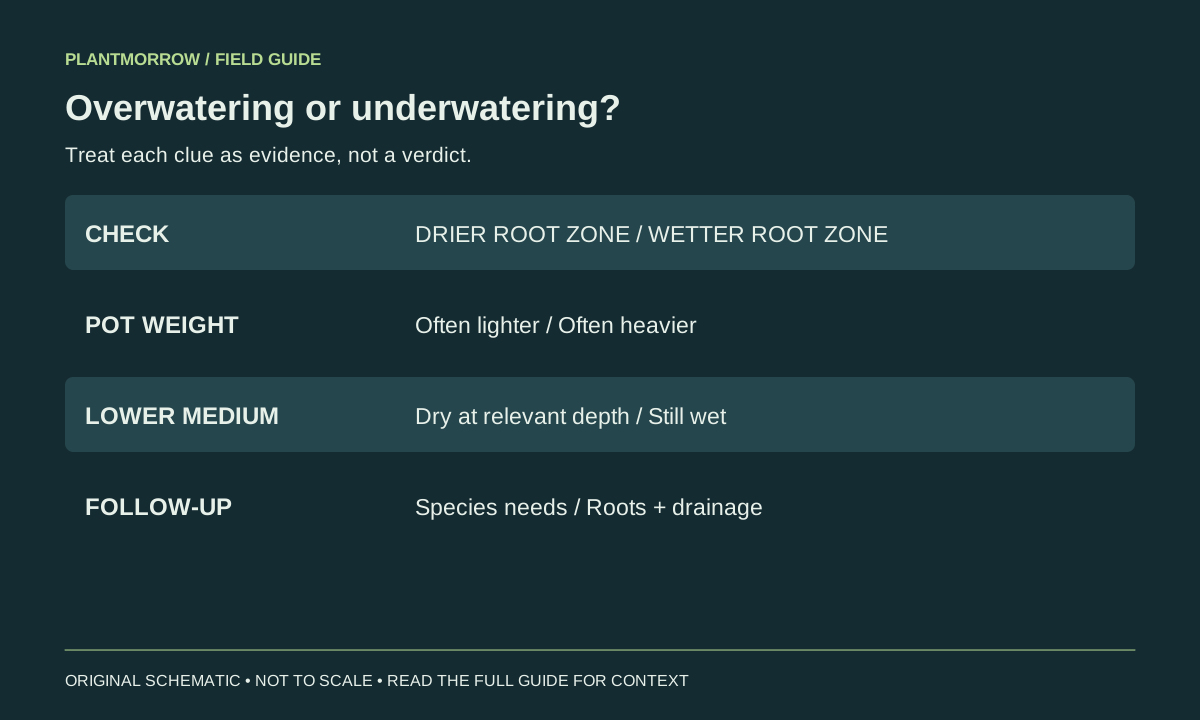
Comparison one: what does the pot actually contain?
Evidence pointing toward insufficient moisture
A pot that is unusually light, with dryness extending through the root ball, supports an investigation of underwatering. Mix may shrink away from the sides, and water may have passed through a gap without wetting the centre. The question is whether the roots had usable moisture, not whether a watering can visited the pot recently.
Check more than the uppermost layer. A finger can assess accessible mix near the surface, while a suitable probe may help in a deeper container. Use care around roots and interpret observations according to the growing medium. One small dry pocket should not be treated as a complete description of a large container.
Evidence pointing toward excessive wetness
A heavy container with persistently wet mix, poor drainage or water standing in an outer pot supports investigating excessive wetness. Compare it with its normal condition after watering and drainage. Water remaining in the pot is more informative than a vague memory that the plant is watered only once a week.
A wet surface also needs context. Some media look damp while the original nursery plug remains dry, or the reverse can happen after repotting. Inspect the root ball that the plant is actually using. If the central and outer materials behave differently, a single surface reading can give a misleading answer.
Comparison two: why can both plants wilt?
Underwatering can leave too little moisture available to replace what the leaves lose. Excessively wet conditions can compromise roots and their ability to supply the plant. The visible posture can therefore overlap even though the immediate conditions around the roots differ. University extension diagnostic guidance treats wilting as a clue with several possible causes.
Check timing. Did the plant wilt after a hot afternoon, gradually decline over several weeks or change soon after repotting? Does it recover as conditions moderate? These observations do not replace the moisture check, but they help you understand whether the symptom matches the proposed explanation.
Also distinguish wilting from a naturally arching leaf or a broken stem. A mature plant may look different from a tightly arranged nursery specimen without being in crisis. Photograph the whole plant and compare with an earlier image if you have one. For a question-led investigation, use the drooping plant clinic.
Comparison three: what can yellow and brown leaves tell you?
Leaves record stress without neatly labelling its cause. Yellowing can accompany prolonged wetness, drought, unsuitable light and other issues. Brown tips can follow several care problems too. Look at the distribution and progression: one old lower leaf differs from rapidly changing foliage across the plant.
An old damaged leaf may remain after moisture conditions improve. If you use that leaf as your only measure, you may repeatedly adjust care in response to injury that has already happened. Record existing damage and watch for new symptoms. Our yellow leaves notebook offers a practical way to organize that pattern.
Do not assume a plant needs fertilizer because water-related stress has made it pale. Feeding changes the root environment and does not establish what went wrong. First investigate water availability, drainage and root condition. Nutrient questions can be considered later if evidence supports them and the plant is in a condition to use fertilizer appropriately.
Comparison four: is the problem quantity, frequency or delivery?
Overwatering is not usefully defined as pouring a large amount once. A suitable container can receive a thorough watering and then drain. The problem may be repeated applications before the root environment needs them, a poorly draining mix or a container that retains standing water. Concentrate on the resulting conditions rather than the size of the jug.
Underwatering can result from waiting too long, applying too little or failing to wet the root ball. Frequent tiny sips can leave deeper roots dry. Water can also travel rapidly down the side of a dried plug. Seeing runoff therefore does not always prove that the mix was evenly rewetted.
Review the complete arrangement: inner pot, drainage holes, saucer, cover pot and growing medium. Check whether roots or debris obstruct drainage. If the container has no outlet, simply adjusting the calendar may not resolve the problem. The houseplant pots guide explains why the growing pot and decorative exterior need to be considered together.
Comparison five: what does root condition add?
Root inspection can be worthwhile when persistent wetness, declining growth or a deteriorating base suggests a deeper problem. It is not a requirement to uproot every plant with an imperfect leaf. First collect the less disruptive evidence. If you inspect, prepare a clean surface and handle the plant carefully to avoid unnecessary damage.
Look at structure as well as colour. Sound roots are generally firm for their species; deteriorating roots may be soft, collapsing or losing their outer tissue. Root colour varies and can be affected by the medium. A dark root is not automatically rotten, and a quick photograph cannot identify every possible pathogen.
A plant with extensive root loss may remain wilted even after the pot's moisture changes. At that point, the question is no longer simply when to water next. The root rot guide covers assessing remaining tissue and deciding whether a recovery attempt is practical. Severe damage can be irreversible.
At the desk: three hypothetical comparisons
The dry centre hidden inside a damp new pot
Imagine a recently repotted plant surrounded by fresh, damp mix. The owner assumes it cannot need water, but the original root ball is dry and irrigation has mostly entered the outer material. The evidence describes uneven delivery, not a simple choice between two whole-pot labels. The next step is to check how both materials receive and retain moisture.
A useful correction must address that actual arrangement. Repeatedly wetting only the outer mix could increase saturation there while leaving the centre inadequately hydrated. Conversely, soaking the whole pot indefinitely introduces another risk. Review the repotting method and the medium transition, and obtain species-specific advice if the root ball cannot be managed sensibly.
The wet cover pot beneath a thirsty-looking plant
Now imagine a plant with hanging leaves, a heavy inner pot and water pooled inside its decorative cover. More water would not explain or correct the strongest observation. Empty trapped runoff, check the outlet and investigate the roots if other signs warrant it. Do not assume that removing the puddle instantly restores a damaged root system.
Review how runoff accumulated. Perhaps another person watered after a regular care visit, or the pot drained into an exterior container that nobody checked. A practical fix includes that human routine. Otherwise, the same problem can recur even after a careful one-time inspection. Put clear care instructions beside the plant if several people share responsibility.
The genuinely dry herb on a bright windowsill
Finally, imagine an herb in a small pot whose root ball is dry throughout after warm, bright conditions. Its container is noticeably light and its stems remain sound. Appropriate watering and drainage address the observed lack of moisture. The owner still needs to review why demand exceeded supply and whether the pot is suitable for the growing plant.
These examples are illustrative, not diagnoses of particular photographs. Their value is the sequence: check the plant, inspect the root environment, explain the observations, then act. Similar leaves can lead to different actions because the supporting evidence differs. If the observations conflict, investigate the conflict instead of forcing a quick label.
Choose the first action from the evidence
For genuine dryness, water in a way that reaches the root ball and allows excess to leave. Check the resulting moisture rather than assuming the first application succeeded. Very dry, shrunken mix may need careful repeated applications. University of Maryland Extension notes that rewetting can require more than one application when media have pulled away from the pot.
For excessive wetness, stop adding water automatically and remove standing runoff. Correct obvious drainage faults. If the medium or pot is unsuitable, decide whether repotting is warranted rather than waiting indefinitely for a structurally poor arrangement to improve. If root deterioration is extensive, assess that damage separately from the watering schedule.
Avoid dramatic rescue routines based only on leaf appearance. Do not apply household chemicals, fertilizer or extreme heat to the roots. Do not strip functioning foliage or repeatedly repot in search of an immediate visual change. A measured correction is easier to evaluate and creates fewer additional stresses while the original problem becomes clearer.
Build a routine that notices change
Learn the container's weight after a normal watering and drainage, then compare it as the plant uses moisture. Combine weight with direct observations and species knowledge. Weight alone becomes less reliable when the container is very large, the pot is changed or other objects share the outer container.
Use calendar reminders to inspect rather than to deliver a fixed dose. Water use can change with growth, light, temperature and the season. A schedule that suited a plant beside a bright summer window may keep it wet after a move to a darker location. Similarly, an actively growing plant may use available moisture sooner than it once did.
Record a few useful details for several checks: root-zone condition, pot weight, watering method and new symptoms. This need not become an elaborate spreadsheet. A short note prevents uncertain memories such as I think it was watered recently from driving the next decision. Keep old leaf damage separate from evidence that the problem is continuing.
Use the next check to test the explanation
Return to the specific observation that prompted your action. If runoff was trapped, confirm that it no longer collects. If the centre was dry, check that your watering method reached it. If a hot position increased demand, observe conditions during that same part of the day after adjusting the placement.
A useful follow-up does not require disturbing the roots repeatedly. Compare posture, new symptoms and the changing moisture condition first. Where the plant continues to decline, revise the explanation rather than repeating the original action more often. Keep a note of the correction and its date so you can share an accurate sequence if outside help is needed.
Questions from the comparison desk
Does a moisture meter settle the question?
A meter can be an additional observation, but its reading needs context and suitable use for the medium. Check more than one relevant area and compare with direct observations. A single number does not identify root rot, describe every part of a pot or replace knowing the plant's requirements.
Should every houseplant dry out completely between waterings?
No. Species differ in how much drying they tolerate. A succulent and a moisture-loving foliage plant should not share an unexamined rule. Learn the plant's needs, then use the root-ball evidence to decide when those needs call for water. Complete dryness is not a universal preventive treatment.
If watering makes a plant stand up, was it definitely underwatered?
Recovery after an appropriate watering supports that explanation when the root ball was genuinely dry, but consider the full observations. Other conditions may have changed at the same time. Do not repeatedly drive the plant to wilting as a test; prolonged drought can cause lasting injury even if earlier episodes appeared reversible.
Can one pot contain both wet and dry areas?
Yes. Different materials, a compact centre, root distribution or uneven delivery can create contrasting conditions. Check where the roots actually are. This is especially useful after repotting or when water runs straight through a container while the plant continues to show stress.
What if I still cannot tell which problem I have?
Keep the plant in suitable conditions and seek advice with clear evidence. Provide its identity, whole-plant and close photographs, the drainage arrangement, recent watering and actual moisture observations. Ask what further inspection would distinguish the possibilities. A useful uncertainty is safer for the plant than an unsupported instruction to add more water.
Read further
Sources & further reading
Selected horticultural references used to inform this guide. Local conditions and species-specific advice still matter.
- University of Maryland: Drought Stress to Indoor Plants
- UC IPM: Houseplant Problems
- RHS: Leaf damage on houseplants
Prepared with AI assistance for Plantmorrow. No independent expert review or first-hand growing trial is claimed. Our editorial approach · Suggest a correction.