A drooping indoor plant does not automatically need water. Leaves lose their normal posture when water supply, root function or the surrounding conditions cannot support them as usual. A dry root ball is one explanation; persistently wet, damaged roots can produce a similar appearance. Start by checking the pot before reaching for the watering can.
Think of this article as a short clinic conversation. Each question narrows the next useful observation. You do not need a collection of instruments or a confident disease name to begin, but you do need to resist treating every limp leaf in the same way.
Is the plant actually wilting, or has its position changed?
Look at the plant's usual growth habit. Some leaves arch naturally, some stems trail, and some plants change leaf position through the day. A leaf leaning toward a light source is not necessarily the same as a soft stem that can no longer support itself. Compare the plant with an earlier photograph if you have one.
Describe the change precisely. Has the whole plant become limp, or is one stem bent? Are petioles flexible, leaves curled, or stems visibly creased? A single broken stem may need a different response from a uniform loss of firmness. Check for physical damage from moving the pot, pets or a crowded growing space.
Record the timing. A change that appears during a hot afternoon, after a move, or immediately after repotting has a useful context. That context is not a diagnosis, but it helps you decide whether to investigate moisture, heat, handling or a combination. Avoid judging a plant entirely from a picture taken at an unfamiliar time of day.
What does the root ball feel like below the surface?
Check the mix at more than its exposed top layer. In a deep container, the lower portion may stay moist after the surface changes colour. A fingertip can help in a small pot; a clean wooden probe may provide another observation in a larger one. Do not force a probe through a tightly packed root system.
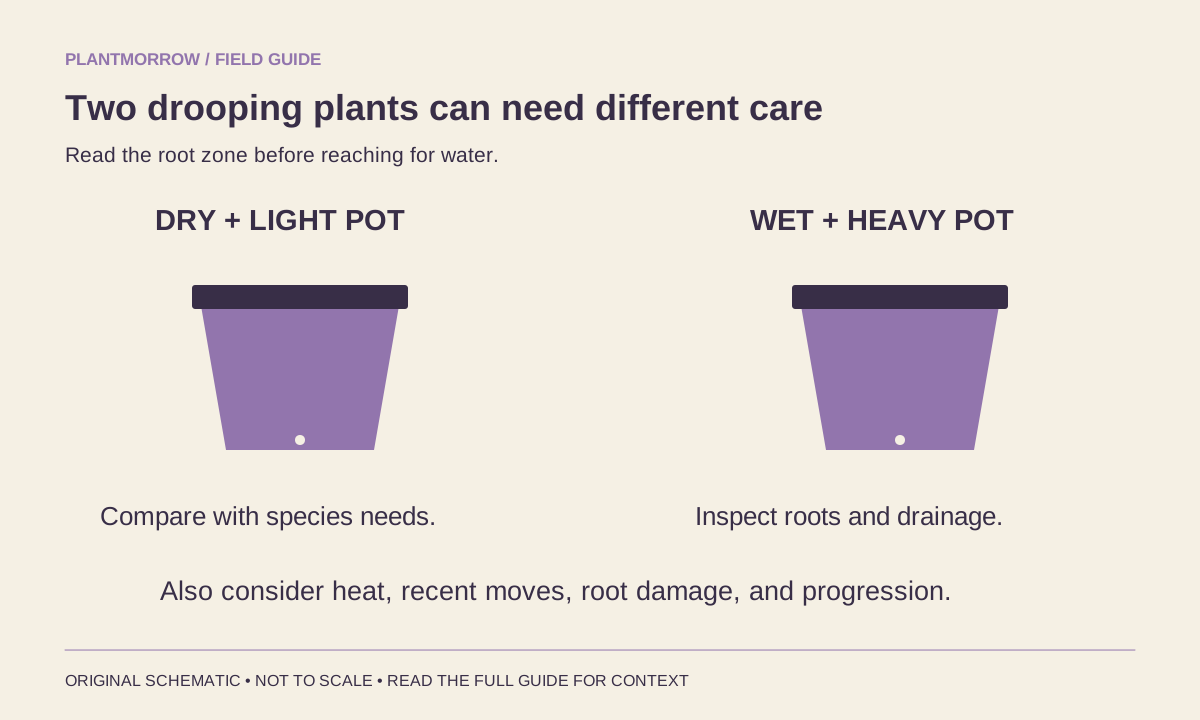
Lift the pot if you can do so safely. A plant that is much lighter than after its last thorough watering provides different evidence from a heavy pot surrounded by standing water. Comparing the same pot over time is more useful than expecting every container to have a particular weight.
Look inside any decorative cover pot. Check whether the inner container has drainage openings and whether runoff has accumulated below it. “I watered only once this week” does not describe the current root environment if the water never left. Our watering comparison explains why surface appearance and calendar frequency can be misleading.
If the mix is genuinely dry, what should I do?
For a plant whose species and condition support the decision, rewet the root ball thoroughly and allow excess water to leave through the drainage holes. Water should reach the root area rather than merely darkening a small patch on top. Place a manageable pot somewhere runoff can drain without damaging furniture or flooring.
Very dry mix can pull away from the container or wet unevenly. If water immediately escapes down a gap, slow down and check whether the centre has actually absorbed moisture. More than one gentle application may be needed. Do not assume that fast runoff proves the plant is fully watered.
Afterward, empty collected runoff and give the plant a suitable, stable environment. Avoid repeatedly adding water because the leaves have not straightened within minutes. Different plants respond differently, and leaves with permanent damage will not necessarily recover their old appearance. Check moisture again before deciding that the initial watering was insufficient.
If the plant has a specialized drying cycle, follow guidance for its identity rather than treating this as a generic soaking prescription. Cacti, succulents and moisture-loving foliage plants cannot all be managed with the same expectations. An unknown plant is a reason to seek identification, not to use the most intensive treatment you can find.
If the mix is wet, why is the plant still drooping?
Wet mix does not guarantee that roots are functioning well. Persistent saturation, poor drainage, damaged roots or an unsuitable container can interfere with the plant's ability to supply its foliage. The University of Maryland's diagnostic guidance includes both insufficient water and root problems among explanations for wilting.
Remove standing water and check obvious drainage problems first. Do not add another drink simply because the foliage looks thirsty. If decline continues, or the stem base is soft, a careful root inspection may be warranted. Support the root ball, look for texture changes and avoid assuming that every naturally dark root is dead.
Our root rot guide separates firm roots from clearly deteriorating tissue and discusses when repotting, propagation or discarding may be appropriate. A casual home inspection cannot identify every pathogen. Avoid applying a sequence of household chemicals in the hope that one will solve an unconfirmed disease.
In a large or fragile plant, unpotting can be difficult and risky. You may need assistance or professional advice rather than pulling at the stem. The purpose of inspection is to gain useful evidence while preserving viable tissue, not to expose every root at any cost.
Could heat, light or moving air explain the timing?
Check the position at the time symptoms appear. Strong sun through glass, a hot conservatory or warm air from a vent can increase stress even when the plant has moisture available. A pot near an opened door or cold window can experience a different problem. Describe the local situation rather than relying on the room thermostat alone.
A plant that changes posture during a hot period may improve as conditions moderate, but repeated or prolonged wilting deserves attention. Do not turn temporary recovery into a reason to ignore the underlying environment. Equally, do not move every drooping plant into a dark cupboard; reduced light is not a universal rescue method.
Match the position to the species and avoid abrupt extremes. A sensible adjustment might reduce a specific exposure while retaining appropriate light. Keep a record of what you changed so that a later observation can test the explanation. Read the light requirements guide for a more useful description of window conditions.
Has the plant recently been repotted or moved?
Consider what happened during handling. Roots may have been disturbed, a root ball may have been divided, or the new mix may behave differently from the old material. A loose plant in a large fresh pot is not necessarily experiencing the same conditions it had before the move.
Check that the original root ball and surrounding mix are both receiving appropriate moisture. A dry central plug can coexist with damp outer material. Conversely, a compact wet centre can remain saturated while a loose surface looks dry. Investigate these differences before treating the entire container as a uniform block.
Avoid immediately undoing a repot unless there is a clear problem to correct. Repeated disturbance can compound the stress. Review pot size, drainage, planting depth and the condition of the stem base. If the pot is plainly unsuitable, correct that issue carefully rather than following a rule that all repotted plants simply need time.
The repotting guide covers preparation and aftercare. Its practical steps are more useful than assuming that a new container is always an improvement or that fertilizer will compensate for damaged roots.
What other signs should change the investigation?
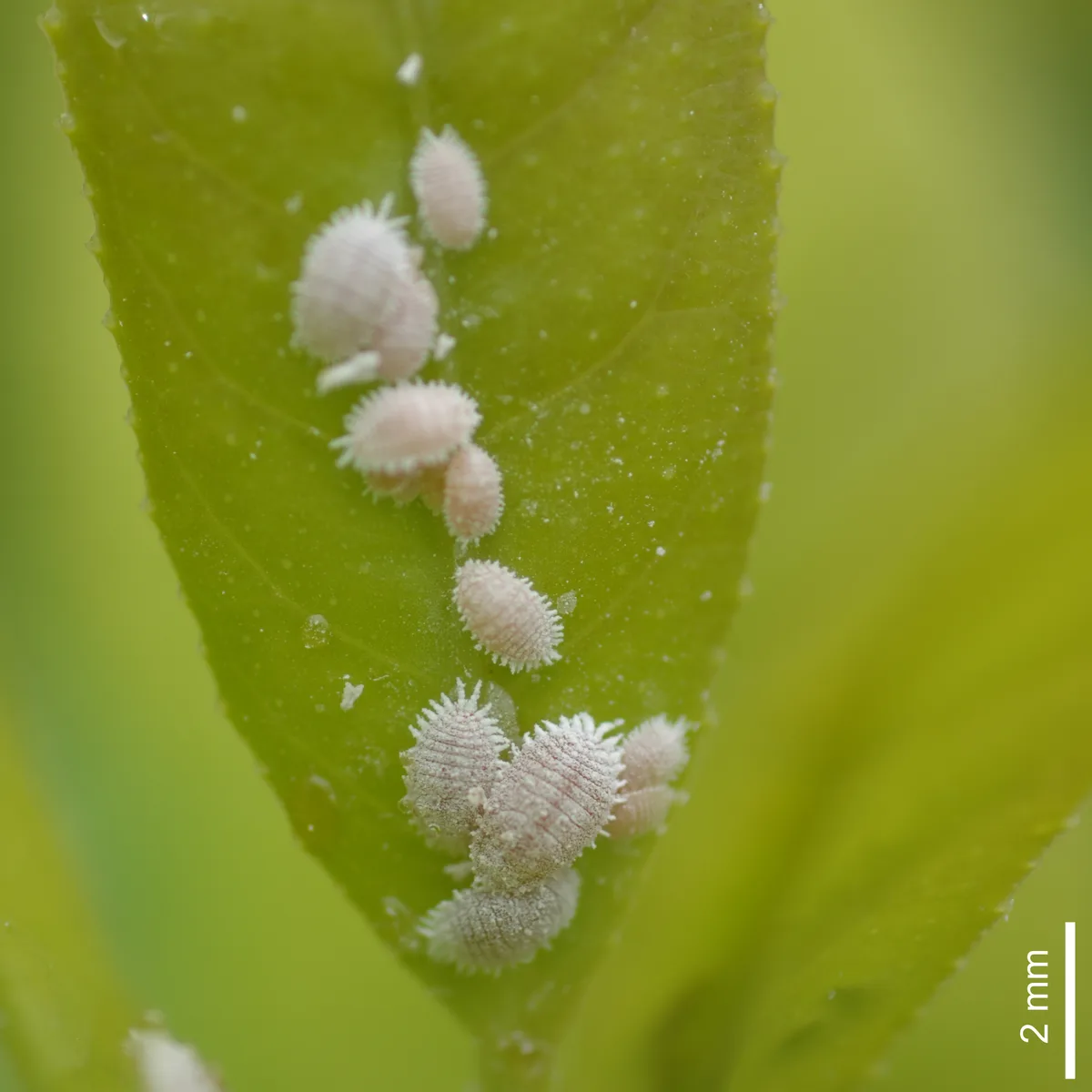
Inspect leaf undersides, stem joints and new growth. Visible insects, cottony deposits, sticky residue or fine webbing may require pest identification. Discoloured areas on stems, extensive softness or a rapidly collapsing crown deserve particular attention. A drooping plant with additional signs should not be assessed from posture alone.
If pests are suspected, separate the plant while you identify them and check nearby plants. Avoid using a random spray before confirming what you are trying to manage. Some products can injure foliage or are unsuitable for an indoor setting. Use local advice and label directions whenever a pesticide is involved.
Do not infer a deficiency merely because a drooping plant also looks pale. A weak root system can create several visible symptoms at once. Check the root environment and recent treatment history before feeding. A photograph of a leaf is rarely enough to distinguish all these possibilities confidently.
How can I tell whether my first action helped?
Choose a meaningful comparison. After correcting genuine dryness, check whether the root ball is now evenly moist and whether the plant's posture stabilizes. After removing trapped water, confirm that it is no longer collecting. After changing a hot position, observe conditions during the period that previously caused trouble.
Keep old damage separate from new damage. A leaf that was already creased, scorched or dead may not look better even if the current problem has stopped. Watch for continued collapse, new symptoms or sound new growth. Take another photograph from the same position rather than repeatedly bending leaves to test them.
Do not promise yourself a fixed recovery time. A mildly dry herb and a houseplant with major root loss are different situations. If the plant keeps deteriorating, revisit the evidence or seek more help instead of repeating the same action more frequently. A short care record makes that conversation far more useful.
What would three different clinic visits look like?
Imagine three plants arriving with similarly hanging leaves. These are hypothetical examples to show how the questions change the next step, not diagnoses of a particular photograph.
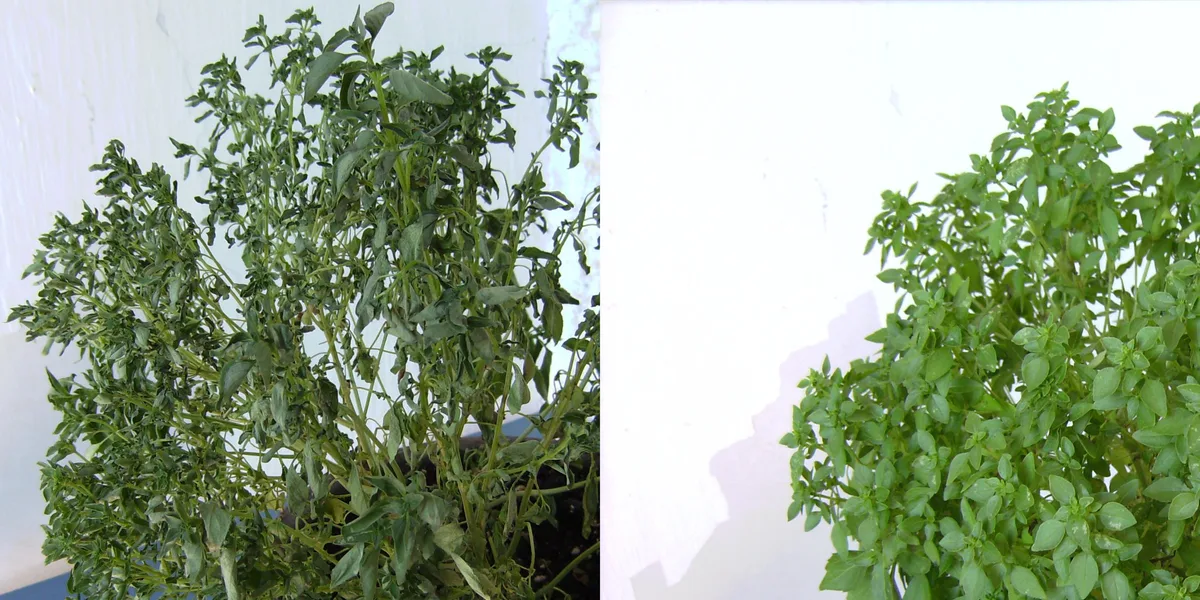
The first is a basil plant in a small nursery pot. Its container is unusually light, the mix is dry through the root ball, and a recent warm afternoon increased water demand. There is no standing water in the cover pot. Appropriate, thorough watering followed by drainage is a reasonable response to those observations. The owner then checks whether the root ball actually became moist, because water running down a gap at the side could leave its centre dry.
The second is a peace lily whose outer pot contains water. Its mix remains wet several days after irrigation, and lower leaves are yellowing. The useful first action is to remove trapped water and investigate drainage and root condition. Adding more water because the leaves hang would ignore the strongest evidence. If inspection reveals substantial root damage, a change in watering alone may not be enough, and recovery cannot be promised.
The third is a recently moved plant beside a sunny window. The root ball is appropriately moist, stems remain sound, and the drooping is most noticeable during the hottest part of the day. Here the investigation follows the temperature and exposure pattern. A more suitable position may address that stress, while unnecessary repotting would introduce an additional disturbance without explaining the original timing.
All three owners can make the same useful record: the plant's identity, a photograph, the actual moisture condition and the time symptoms develop. The actions diverge because the evidence diverges. If a plant does not fit any of these examples, keep asking questions. Symptoms are clues that guide inspection; they are not a requirement to choose the nearest familiar story. Share those observations with a local extension service or knowledgeable horticulturist when the cause remains unclear.
Short answers to common clinic questions
Should I mist the leaves to revive the plant?
Misting does not rehydrate a dry root ball or repair damaged roots. Moisture on leaves also does not identify the cause of wilting. Focus first on the plant's identity, root-zone condition and environment. If the species needs higher humidity, plan an appropriate long-term environment rather than using mist as an emergency substitute for diagnosis.
Should I cut off all drooping leaves?
No. Drooping does not necessarily mean a leaf is dead. Remove clearly dead or badly damaged material when appropriate, but retain functioning foliage where possible. Excessive pruning adds another stress and makes the plant's response harder to assess.
Can a drooping plant be overwatered and underwatered at the same time?
Different parts of a container can have different moisture conditions, and damaged roots can limit water supply even in wet mix. This is why the inspection needs to include the actual root ball rather than a single surface reading or a simple label.
What should I send when asking for help?
Send a whole-plant image, a close view of affected tissue, the pot and drainage arrangement, and the plant's name if known. Include watering method, moisture observations and recent changes. Describe whether the problem is sudden or progressive and whether the same thing is happening to neighbouring plants.
Read further
Sources & further reading
Selected horticultural references used to inform this guide. Local conditions and species-specific advice still matter.
- University of Maryland: Drought Stress to Indoor Plants
- University of Maryland: Diagnose Indoor Plant Problems
- UC IPM: Houseplant Problems
Prepared with AI assistance for Plantmorrow. No independent expert review or first-hand growing trial is claimed. Our editorial approach · Suggest a correction.