Fertilize a plant when it has a reason to use additional nutrients, not simply because a reminder appears on your phone. Active growth, the nutrients already present in its growing medium, the type of plant and the product label all belong in the decision. A yellow leaf by itself is not a diagnosis of hunger, and fertilizer does not replace light, water or functioning roots.
Indoor and outdoor plants also live in different systems. A houseplant has a limited container volume, while an established garden plant may obtain what it needs from a much larger soil environment. This planner helps you choose when to feed, when to wait and what information to gather before adding anything.
The first gate: is the plant growing?
Look for actual activity: expanding leaves, extending shoots or the growth stage described in the plant’s care instructions. A calendar season can offer context, but it cannot show you what a particular plant is doing. Indoor heating, artificial light and local climate can all separate a plant’s behavior from a generic seasonal chart.
Many ordinary houseplants grow more actively when light and temperature support them and slow down in less favorable conditions. The UConn houseplant fertilization guide connects feeding with active growth. Its calendar references describe a particular setting; they should not be copied unchanged to every hemisphere or growing environment.
If a plant has stopped growing because its light is inadequate, more fertilizer does not supply the missing energy. Check its position and overall condition first. Likewise, a plant with damaged roots may struggle to use additional inputs, even when its leaves look pale or its growth has slowed.
Write a simple description before deciding: actively growing, recently repotted, resting, flowering, cropping or recovering. The description does not need to be a perfect scientific classification. Its purpose is to make you consider the plant’s condition before opening the fertilizer container.
The second gate: what nutrients are already there?
Read the label on the potting mix used most recently. Some media contain a starter charge or a longer-release fertilizer, while others provide very little nutrition. If you add another product without checking, you may unintentionally overlap two feeding programs.
For an outdoor bed, consider previous compost, manure, fertilizer applications and the results of an appropriate soil test. A soil that looks dark is not automatically balanced, and a productive-looking garden does not prove that every nutrient should be added again. Make amendments in response to information rather than color alone.
The RHS feeding guide distinguishes plants that may need regular additional feeding from many established garden ornamentals that do not. Container plants and productive crops often require closer attention, but that is not a reason to fertilize every plant at the same rate.
If you do not know what was applied previously, start by finding that information. Photograph the bags and product labels, ask whoever maintained the plants, and record the date of any known treatment. A short investigation can prevent an unnecessary application more effectively than guessing a lower dose of several overlapping products.
Read a fertilizer label as instructions, not decoration
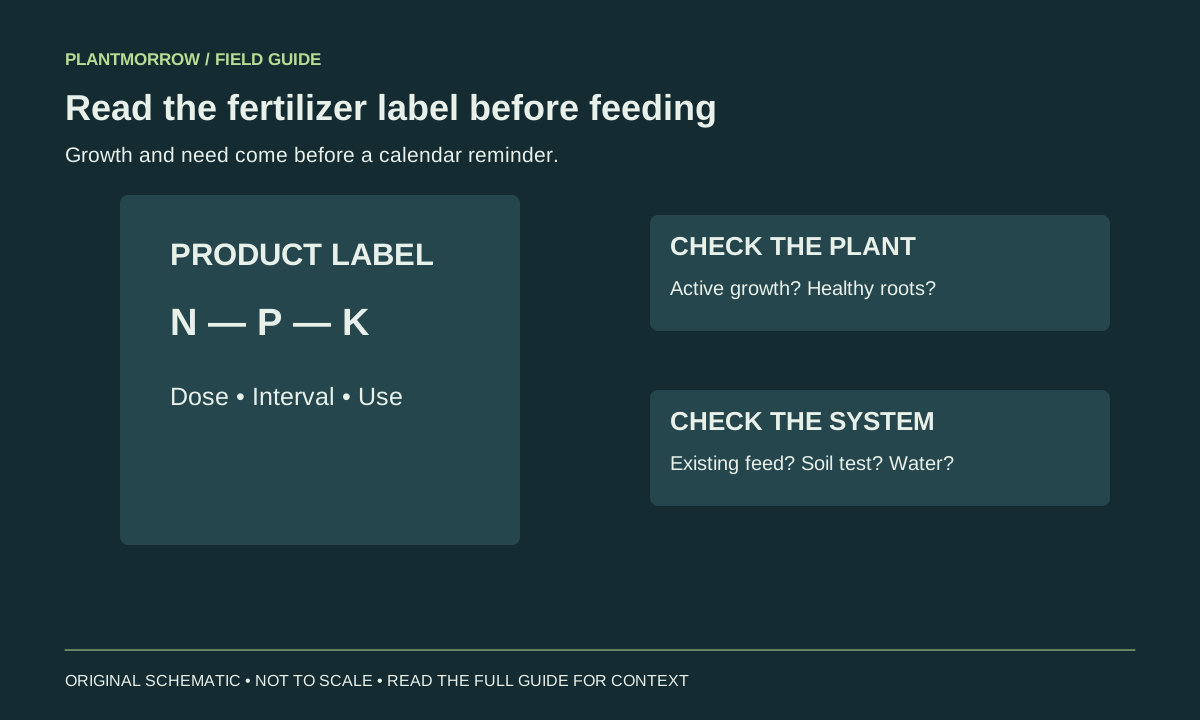
The familiar three-number analysis describes nitrogen, phosphorus and potassium in the labeling system used for that product. These numbers help you compare formulations, but the highest numbers do not mean the best fertilizer. Concentration, intended use, application method and dilution instructions matter just as much.
Choose a product labeled for the plant group and situation you are managing. An indoor liquid feed, a controlled-release container product and a garden fertilizer can have very different directions. Do not translate a scoop size from one package to another, even when the plants on the front look similar.
Measure carefully with a dedicated tool, not a kitchen utensil that will later return to food preparation. Follow the stated amount, timing and method. Keep the product in its original labeled container, store it safely and prevent access by children and pets. Natural or organic descriptions do not remove these responsibilities.
More frequent applications are not automatically gentler if their combined nutrient amount exceeds the intended program. Likewise, mixing a weaker solution but applying it repeatedly can still create an excessive total. Follow a coherent set of directions instead of combining advice from several different feeding routines.
Plan A: a growing houseplant in a container
Confirm that its light, watering and drainage are appropriate, then check whether its medium already contains fertilizer. If the plant is actively growing and additional feeding fits the product and plant guidance, choose one suitable program and record the application date.
With a water-soluble product, follow its dilution directions and any instructions about the moisture condition of the medium before application. Do not apply an improvised concentrated dose to a very dry or distressed root ball. If the product is intended to be watered in, ensure that drainage can escape from the inner pot.
Keep the subsequent observations modest. A plant does not need to show a dramatic change immediately after every feed. Look at the quality of new growth over time while continuing to monitor water and light. The response of one leaf is a poor basis for abruptly increasing the dose.
For a hypothetical collection of six houseplants, create a small list with the product, date and any exceptions. One may have fresh pre-fertilized medium, another may be resting, and a third may be recovering from root trouble. A shared shelf is not a reason to treat all six identically.
Plan B: outdoor vegetables and plants in pots
Productive crops in containers rely on a limited root environment that is watered repeatedly. Match feeding to the crop, the medium’s existing nutrients and the directions for the selected product. A tomato carrying fruit and a newly planted herb do not necessarily need the same treatment simply because they share a patio.
Check water supply before treating slow growth as a feeding problem. A small container that repeatedly dries out, an oversized pot that stays wet or a shaded growing position can each interfere with progress. Adding nutrients without correcting the basic setup can make the situation more confusing.
If you use a controlled-release product, record when it was applied and the label’s intended period of use under the relevant conditions. Do not assume that visible granules mean the product is still supplying the original amount, or that an arbitrary number of months applies to every formulation.
For crops in a bed, follow locally appropriate soil-test and crop guidance. Your region’s growing season, soil characteristics and environmental rules matter. The container vegetable guide and garden soil guide explain the different root environments behind these choices.
Plan C: established garden ornamentals
An established shrub or perennial in suitable soil may not need the routine feeding schedule used for container crops. Start with growth, soil information and the plant’s specific requirements. Adding fertilizer every time you feed a patio pot can be unnecessary for plants growing nearby in the ground.
Consider soil management and surface organic matter as part of the wider system, while recognizing that compost is not a precisely standardized fertilizer. Its composition varies, and repeated additions can contribute nutrients as well as alter soil structure. More organic material is not automatically the right answer to every soil question.
If a plant is weak, identify whether competition, damaged roots, waterlogging, unsuitable pH or another condition is involved. A fertilizer recommendation should address a real need, not substitute for understanding the site. Some problems require a different location or a cultural adjustment rather than another product.
Choose a manageable intervention and a way to judge it. Note which plant or bed received an application and what you expected to improve. Avoid scattering several products over the same area while leaving no record; later observations become almost impossible to interpret.
When the answer is to wait
Pause routine feeding when a plant is not actively using it, when product instructions say to pause, or when the plant’s immediate problem needs investigation. Newly acquired plants, recently repotted plants and stressed specimens deserve a check of their history and condition before additional nutrients are supplied.
Signs such as leaf-tip damage, wilting or crust on a container can have multiple explanations, including possible fertilizer-related issues. They are not a request for a stronger dose. Review the previous applications, the medium, drainage and water quality before deciding what to do next.
If excess fertilizer may have been applied, stop adding more and consult reliable guidance for that plant and product. Any corrective watering must take drainage and root condition into account; repeatedly flooding a pot that cannot drain creates another problem. Keep product packaging available if you seek advice.
Read overwatering versus underwatering before interpreting every wilt as a nutrient shortage. Water and fertilizer decisions interact, but they are not interchangeable. A plant that cannot take up water normally will not be repaired by a general feeding routine.
A season-neutral feeding record
Use growth phases instead of a chart that assumes January means winter everywhere. Your record might use four headings: active growth, slowing growth, resting conditions and renewed growth. Add actual observations below each heading so that the plan remains connected to your plants.
| Record field | What to write |
|---|---|
| Plant and location | A name that distinguishes it from similar pots |
| Growth stage | New growth, flowering, cropping, resting or recovering |
| Existing nutrition | Recent mix, compost or controlled-release product |
| Product and dose | Exactly what the label instructed and what you applied |
| Review note | The next observation that will affect the decision |
Do not turn this record into an obligation to fertilize on its review date. The review is a chance to check whether feeding still makes sense. That distinction keeps a useful reminder from becoming an automatic application schedule that ignores changing conditions.
Plan around shared responsibility
Feeding becomes harder to control when several people care for the same collection. A person who sees a pale leaf may add a product without knowing that someone else fed the plant yesterday. Keep the current program visible and make it clear which plants are exceptions, especially after repotting or during recovery.
Prepare working solutions only as directed and label them appropriately if the product instructions allow temporary storage. Never leave fertilizer solution in a drinking bottle or a container someone could mistake for ordinary water. Measuring equipment should remain dedicated to garden use, and concentrated products should return promptly to their original safe storage place.
If someone helps while you travel, a simpler plan may be better than asking them to reproduce several feeding schedules. Make plant-specific watering and observation instructions clear, and decide in advance whether any feeding is genuinely needed during your absence. A temporary pause should be judged against the plant and product requirements rather than assumed suitable for every situation.
On your return, check what actually happened before restarting the ordinary program. The record should distinguish an application from a reminder or intention to apply. This small administrative habit prevents overlapping doses and makes future advice about the plant more accurate, because you can describe what reached its growing medium rather than what someone might have planned.
Frequently asked feeding questions
Is yellow foliage proof that a plant needs fertilizer?
No. Yellowing can have several causes, including watering, roots, light and normal aging. Look at the pattern and the plant’s environment before choosing a treatment. The yellow-leaf troubleshooting guide provides a structured starting point for that investigation.
Should indoor plants be fed during winter?
Use growth and conditions rather than a universal seasonal ban. Many plants slow down under reduced light and need less intervention, while plants in suitable controlled conditions may continue growing. Follow plant-specific guidance and the product label; do not copy another hemisphere’s month-by-month program.
Can compost replace every fertilizer?
Compost contributes to soil management and may add nutrients, but its composition varies. Whether additional feeding is needed depends on the plant, growing medium and available information. A productive container crop and an established garden shrub should not be assumed to have identical requirements.
Is a stronger product better value?
Only if it suits the job and you measure and use it correctly. Compare the labeled amount of working solution or area treated, not just the headline numbers. A product that is awkward to dilute accurately may be a poor practical choice for a small collection.
The next decision to make
Before feeding one plant, identify its growth stage, check its existing medium and read the selected product’s instructions. Record the application only if the evidence supports it. A successful feeding plan is a sequence of justified decisions, including the occasions when adding nothing is the most sensible step.
Read further
Sources & further reading
Selected horticultural references used to inform this guide. Local conditions and species-specific advice still matter.
- Houseplant Fertilization — University of Connecticut
- How to feed plants — Royal Horticultural Society
Prepared with AI assistance for Plantmorrow. No independent expert review or first-hand growing trial is claimed. Our editorial approach · Suggest a correction.