To grow fresh herbs in a small space, begin with the light you actually have and the herbs you regularly cook with. A few separate pots in a suitable position are usually easier to manage than a crowded decorative bowl. Match each plant's moisture and temperature needs, harvest without stripping it bare, and keep the collection small enough to notice changes.
A windowsill, doorstep and sheltered balcony are different growing environments. None becomes a herb garden simply by adding matching labels. This decision guide helps you choose a workable starting arrangement, then adjust it from observations rather than following one care schedule for every fragrant plant.
First decision: indoors or outside?
If you have a bright outdoor place with suitable temperatures, it may offer more useful growing light than an indoor shelf. Check wind, intense reflected heat and access to water before choosing it. Tender herbs also need protection from unsuitable cold, so their outdoor season follows your climate rather than a universal planting month.
If the growing space is indoors, inspect the window from the plant's position. Deep shelves, curtains and nearby buildings can reduce the light that reaches a pot. A room may feel pleasant and bright to a person while offering too little light for a herb to make steady new growth.
The Iowa State indoor-herb guide identifies light as a common limiting factor. That makes lighting a planning decision, not a rescue purchase after several plants decline. Consider a suitable grow light if the available window cannot meet the needs of the herbs you want; follow the fixture's placement instructions rather than copying an arbitrary distance.
If you are unsure, start with one plant and observe its growth before filling the whole sill. New leaves, compact growth and the behavior of the potting mix give you more useful information than the appearance of the plant on the day you bought it.
Second decision: which herbs will you use?
Write a short kitchen list. Someone who cooks tomato sauces may choose basil and oregano, while another household may value parsley, chives or mint. Familiar culinary use gives you a reason to harvest regularly and makes it easier to judge whether the collection is useful.
Do not select unfamiliar plants solely by fragrance or the word “herb.” Obtain correctly identified culinary species from a reliable supplier. Edibility is not established by resemblance to a photograph, and a plant intended as an ornamental may have a different treatment history from one sold for culinary growing.
If you want tender leafy herbs
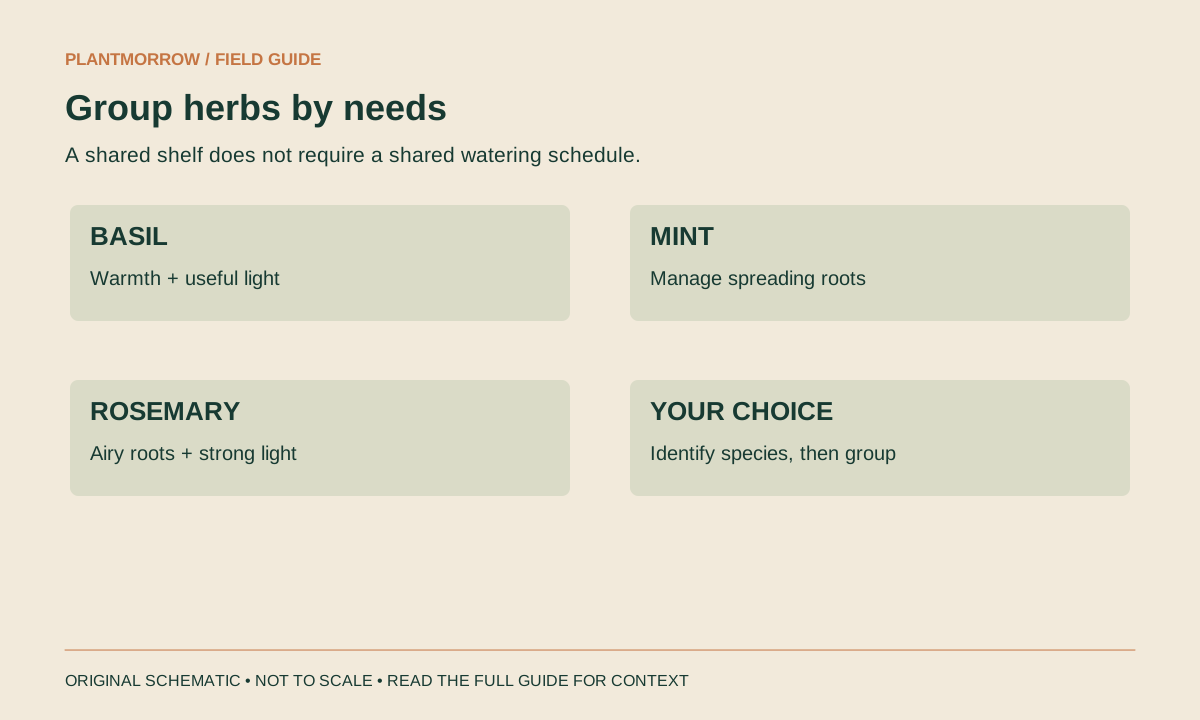
Basil offers a good example of a herb whose appearance can conceal quite specific needs. It wants suitable warmth and useful light, and a pot of dense supermarket seedlings may not behave like one established plant. Check how many stems and root systems are crowded into the container before assuming that the whole clump can stay there indefinitely.
Parsley and cilantro offer different harvest and seasonal patterns. Read their growing instructions rather than expecting every leafy herb to respond to identical cutting. A plant beginning to flower is not always asking for more fertilizer; it may be moving through a normal stage of its life cycle or responding to its environment.
If you prefer woody or perennial herbs
Rosemary, thyme and sage can be attractive long-term choices when the position and root environment suit them. They should not be watered automatically whenever a nearby basil plant needs attention. Their tolerance of indoor conditions and winter exposure differs, so choose species for the actual space rather than creating a permanent mixed arrangement from a cooking theme alone.
If mint is on your list
Give it its own container. A separate pot makes its spreading growth easier to manage and allows you to adjust its moisture independently. Even in a container, an old congested plant may eventually need renewal. “Contained” does not mean that the plant will remain indefinitely healthy without looking at its roots and new growth.
Third decision: individual pots or a shared planter?
Individual pots give a small collection flexibility. You can move one herb into better light, water another less often or replace a finished annual without disturbing its neighbors. Pots do not have to match to make a practical garden; their drainage and suitability matter more than their color.
A shared planter is possible when the herbs have compatible requirements and enough mature space. The Iowa State container-herb guidance specifically recommends comparing water needs when grouping plants. A crowded bowl of herbs may look finished immediately, but that appearance can disguise competition and incompatible care.
Choose pots that accommodate the plant's root system without surrounding a small root ball with a large volume of persistently wet medium. Check for functional drainage holes. If a decorative outer pot is used, make sure water does not accumulate around the growing pot after watering.
Use a suitable container potting mix rather than assuming outdoor garden soil will drain well in a pot. The right medium helps you manage both water and air around the roots. For the distinctions between mix types, see choosing the right potting mix.
Set up a small collection you can reach
Arrange the plants so that each receives light and can be inspected. A second row hidden behind taller pots often gets less useful light than the front row. Rotating the entire arrangement occasionally is not a substitute for putting plants within an appropriate light zone.
Allow room to remove a pot for watering and to reach leaves with clean scissors. Keep surfaces protected from drainage, but do not turn a protective saucer into a permanent water reservoir unless the growing system is designed for it. Near food preparation, keep potting material and gardening equipment separate from clean ingredients and utensils.
For an outdoor shelf or balcony, consider wind and stability. A light pot can become top-heavy as a herb grows. Avoid placing containers where they might fall on someone or block access. If the only suitable light is on a balcony, work through planning a balcony garden before installing shelves or supports.
Label each pot with its species or cultivar and acquisition date. This small record helps distinguish two similar herbs and gives context when an annual begins to decline. It also prevents a well-meaning helper from treating the whole collection as one identical watering job.
Follow the root zone, not the calendar
Inspect the growing medium and lift the pot before watering. As you become familiar with the container, its weight becomes a useful clue alongside touch and appearance. A large plant in a warm, exposed spot can use water differently from a recently potted cutting in a cool window.
When water is needed, moisten the root zone rather than repeatedly adding tiny surface splashes. Allow ordinary pots to drain, then check that the inner pot is not standing in unwanted water. If the medium remains wet for a long time, reconsider the light, container size and drainage before reducing the question to how many days have passed.
Watch the plant as well as the mix. Wilting is a sign to investigate, not an instruction to water regardless of moisture. Roots affected by excess moisture can leave a plant unable to supply its leaves, even when the pot is wet. Use the comparison in overwatering or underwatering when symptoms are ambiguous.
Feeding should match active growth, the growing medium and the product instructions. An indoor plant receiving little useful light may not benefit from the same feeding pattern as an actively growing outdoor herb. Account for any nutrients already included in the mix and avoid trying to force recovery with a concentrated dose.
Harvest as part of growing, not as a final raid
Begin with modest harvests from an established plant. Take what you can use while leaving enough healthy foliage for continued growth. Clean tools give you more control than tearing at stems, and a deliberate cut helps preserve the plant's shape.
The appropriate cut depends on the herb. With branching herbs such as basil, a cut above a suitable pair of leaves can retain a point for further branching. Do not apply that technique indiscriminately to every woody stem or strip a slow-growing plant simply because a recipe calls for a large quantity.
Plan meals around the plant you have. A small new basil plant is not necessarily ready to supply a large batch of pesto, while a few snipped leaves may be a useful harvest. Buying extra herbs for a recipe is a better option than repeatedly removing most of a plant's working foliage.
Wash culinary herbs appropriately before use and keep the identity of each plant clear. Do not use foliage from a plant treated with a product unless its labeling permits the intended edible use and all relevant instructions have been followed. Homemade mixtures do not automatically become safe because their ingredients sound familiar.
Two hypothetical arrangements
A bright kitchen window: one cook starts with parsley and chives in separate draining pots, leaving enough space to lift each one into the sink. The example is deliberately modest. If growth suggests insufficient light, the next decision is lighting or location, not squeezing in additional plants to make the sill look fuller.
A sheltered outdoor corner: another gardener chooses basil for suitable warm weather, plus a separate thyme pot. Because the containers are independent, the gardener can respond to their different moisture behavior. When conditions turn unsuitable for basil, it can be moved, replaced or allowed to finish without disturbing the thyme.
Neither arrangement promises year-round harvests. Its value is that the gardener can observe a small number of plants clearly. The same approach scales to a larger collection only after the space and maintenance routine have proved workable.
Keep a kitchen-sized record
Once a week, note which herbs you actually harvested and which were left untouched. That record can reveal a planning mismatch that plant care alone cannot solve. If a healthy herb is never used, replacing it with something more useful may improve the garden more than adding another pot.
Record what happened to the harvested plant afterward. Did it produce fresh growth, remain stable, or struggle after a heavy cutting? You are looking for a sustainable rhythm between the plant's growth and your kitchen demand. Do not interpret one quick regrowth as permission to remove the same amount repeatedly under different light or seasonal conditions.
For a longer absence, arrange individual care instructions rather than asking someone to water “the herbs” indiscriminately. Grouping the pots for access can help, provided the move does not leave sun-loving plants in a dark corner for an extended period. A simple label saying “check first” is more useful than an untested schedule.
When the arrangement stops working
Leggy growth suggests that light deserves attention, although it is not the only possible explanation. Check where the newest growth is heading, whether neighboring pots have started shading one another and how the pattern has changed with the season. Move or add plants deliberately rather than reshuffling everything at once.
A persistent wet pot, declining roots or repeated wilting calls for a closer investigation. Examine drainage, medium condition and root congestion. A struggling annual may also be nearing the end of its useful productive stage, so replacing it can be more sensible than attempting endless recovery.
The RHS guidance on container herbs distinguishes tender herbs from those that can remain outside under suitable conditions. Translate that distinction to your own climate. Protection from freezing, saturation or extreme heat is a local planning question, not a fixed instruction to move every herb on the same date.
Frequently asked questions
Can I use herbs from the supermarket?
You can try, but inspect their condition and crowding. Many are produced for quick kitchen use rather than long-term growth in the sales pot. A healthy nursery plant or correctly timed seed sowing may be a more straightforward starting point for a permanent collection.
Will a small pot keep an herb small?
It may restrict growth, but restriction is not the same as healthy management. A very small root volume can make watering difficult and eventually leave a plant congested. Choose a suitable pot and manage growth with appropriate harvesting or renewal.
Can all my herbs share one watering day?
Use the day as a reminder to inspect them, not a command to water each pot. Different species, root volumes and positions create different needs. A shared check-in can be efficient while watering decisions remain individual.
What is the simplest useful start?
Choose two correctly identified culinary herbs you regularly use, give them separate draining pots and verify the light. Keep a brief record of watering and harvests. Expand only when you can explain why the first plants are growing well.
Read further
Sources & further reading
Selected horticultural references used to inform this guide. Local conditions and species-specific advice still matter.
Prepared with AI assistance for Plantmorrow. No independent expert review or first-hand growing trial is claimed. Our editorial approach · Suggest a correction.